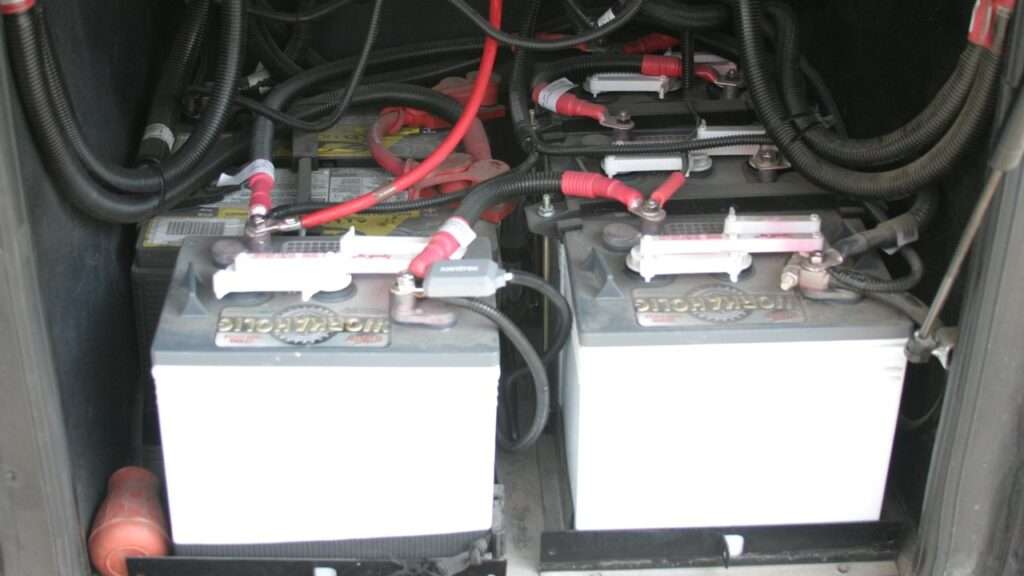
An RV battery powers essential 12-volt systems like lights, fans, and water pumps but cannot directly run high-demand 120V appliances without extra equipment.
Knowing what your RV battery can and cannot power helps you plan trips, avoid surprises, and make the most of your off-grid camping experience. With the right setup, you can stretch your battery life and enjoy more time away from shore power.
Key Summary:
- An RV battery powers 12V systems like lights, water pump, fans, furnace blower, and safety detectors.
- An RV battery cannot power air conditioners, microwaves, coffee makers, or household outlets without an inverter or external source.
- Battery type matters: lead-acid offers low cost, while lithium delivers longer lifespan, deeper discharge, and higher efficiency.
- Smart practices—using LEDs, solar charging, and disconnect switches—help extend runtime and battery life off-grid.
How an RV Uses Electricity From Its Battery
An RV battery supplies 12-volt DC power for lights, fans, pumps, and appliance control boards. It delivers steady, low-voltage electricity for core systems, but cannot handle most household appliances without conversion to 120V through an inverter.
Here’s a breakdown of what the battery supports directly:
- Lights: Interior and exterior lighting run entirely on 12V power.
- Water pump: Provides pressurized water for sinks, showers, and toilets.
- Furnace: Runs the ignition system and blower fan that distributes propane heat.
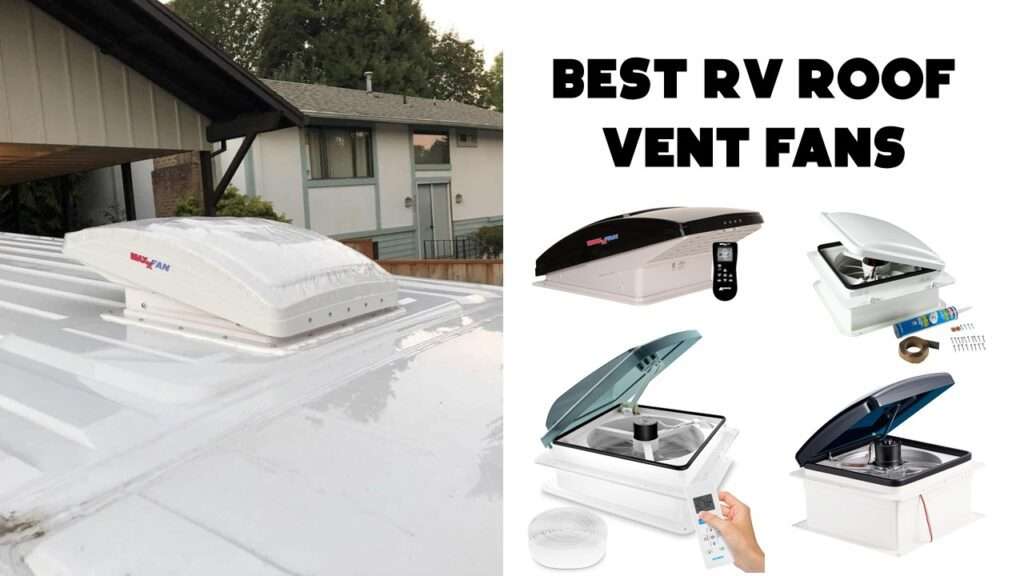
- Ventilation: Operates bathroom fans, roof vents, and range hood fans.
- Control systems: Powers refrigerator control boards, propane igniters, detectors, and safety alarms.
These functions keep your RV livable even when you are dry camping without shore power.
What an RV Battery Powers
An RV battery powers all 12-volt DC systems, including lights, water pump, furnace blower, control boards for propane appliances, fans, slide-outs, and safety devices. These are the essential operations that keep an RV functional when not plugged into external electricity.
Let’s look more closely at each category:
Lighting (Interior and Exterior)
RV batteries keep your lighting system running whether you’re on the road or off-grid. Older rigs often use incandescent bulbs that consume 10–12 watts each. LED upgrades, which only use 3–5 watts, cut lighting energy use by roughly 75 percent compared with 10–12W incandescent bulbs.
Water Pump
The 12V water pump pressurizes the plumbing system so faucets and showers work. It draws power only when activated, typically around 5–7 amps, making it an intermittent but important load.
Furnace Blower and Ignition
The furnace generates heat with propane, but it depends on the battery to run the blower motor and ignition system. This makes heating one of the biggest battery drains in cold weather, especially if the furnace cycles frequently overnight.
Propane Appliance Control Boards
Even propane-driven systems like refrigerators and water heaters need electricity. The RV battery powers the control boards, thermostats, and igniters, which ensures these appliances function safely and reliably.
Ventilation Fans and Range Hood
Roof fans, bathroom vents, and kitchen hood fans all rely on battery power. Small fans usually draw 10–25 watts, while larger fans can consume up to 60 watts depending on speed settings. Ventilation is crucial for comfort and air circulation inside the RV.
Slide-Outs and Electric Jacks
Extending slide-outs and operating electric stabilizers or tongue jacks require short bursts of high current. A slide motor may pull 30–40 amps, but only for a few seconds at a time. This makes them high-demand but low-duration loads.
Safety Systems
Safety features such as LP gas detectors, carbon monoxide alarms, and smoke detectors all run on battery power. These devices draw minimal current but operate continuously, so they slowly drain the battery over time.
Other 12V Electronics
Many RVs include 12V televisions, stereos, routers, and Wi-Fi boosters that can run directly from the battery. These conveniences make off-grid camping more enjoyable but add to the overall electrical demand.
What an RV Battery Cannot Power Without an Inverter?
Featured snippet answer: An RV battery cannot run standard 120-volt appliances like air conditioners, microwaves, coffee makers, or household outlets unless paired with an inverter or connected to shore power or a generator.
Here are the appliances that require 120V power:
- Air conditioner: Needs 1,500–1,800 watts continuously, far beyond a single battery’s capacity.
- Microwave: Typically draws 1,000 watts or more, making it impossible without an inverter.
- Kitchen appliances: Coffee makers, toasters, and induction cooktops require 120V AC power.
- Wall outlets: Standard outlets in an RV only work when connected to shore power, a generator, or an inverter.
This distinction is key: your RV battery can cover basic living needs, but heavy appliances demand an additional power source.
RV Battery Basics Every Owner Should Know
RV batteries supply the 12-volt DC power needed for lights, fans, water pumps, and safety systems. They come in different types and voltages, and knowing the basics helps you pick the right battery, size your setup, and maintain it properly.
Understanding these fundamentals gives you a foundation for troubleshooting problems and planning upgrades.
RV Battery Types
The main RV battery types are flooded lead-acid, AGM, gel, and lithium. Each has its own costs, lifespans, and maintenance needs.
- Flooded lead-acid: Affordable and widely available but require topping off with distilled water and ventilation.
- AGM (Absorbent Glass Mat): Sealed, maintenance-free, and resistant to vibration, though more expensive.
- Gel: Spill-proof and low-maintenance but charge more slowly and are less common today.
- Lithium (LiFePO₄): Lightweight, efficient, and long-lasting, with higher upfront cost but the best long-term value.
RV Battery Chemistry
RVs rely on deep-cycle batteries because they deliver steady power over long periods. Unlike starter batteries that provide short bursts to start an engine, deep-cycle batteries are designed to discharge and recharge repeatedly without harm, making them ideal for powering RV systems.
What Is the Voltage of RV Batteries?
Most RVs use 12-volt batteries, which match the voltage requirements of lights, pumps, and other onboard electronics. Some setups pair two 6-volt batteries in series to create a 12-volt system with greater durability and capacity.
How to Check the Power Level of Batteries
The easiest way to check a battery’s state of charge is with a multimeter or a dedicated battery monitor. A fully charged 12-volt battery typically reads 12.6–12.8 volts. While a multimeter gives a quick snapshot, a shunt-based monitor is more accurate because it tracks both amps in and amps out.
RV Battery Lifespan and Durability
RV battery lifespan depends on the type, usage, and care. Lead-acid batteries generally last 3–5 years, AGM models 4–7 years, and lithium batteries 8–12 years or longer. With proper charging and maintenance, you can maximize their performance and delay costly replacements.
How Long Do RV Batteries Typically Last?
Flooded lead-acid batteries usually last 3–5 years if properly maintained. AGM batteries stretch that to 4–7 years, while lithium batteries can last 8–12 years with thousands of charge cycles. Factors like discharge depth, temperature extremes, and charging habits play a big role in how long a battery actually lasts.
What Is the Longest-Lasting RV Battery?
Lithium (LiFePO₄) batteries are the longest-lasting option. They can provide up to 5,000 cycles, tolerate deeper discharges, and stay efficient for a decade or more. While they cost more upfront, they often save money in the long run thanks to their durability.
How Many Batteries Do I Need in My RV?
The number of batteries you need depends on how you camp and how much power you use. Weekend campers often manage with a single 100Ah battery. Frequent boondockers or remote workers usually need 200–400Ah or more. Running an air conditioner requires a large lithium bank of 400–600Ah combined with a powerful inverter.
Charging and Maintaining RV Batteries
RV batteries can be charged through shore power, solar panels, a generator, or the alternator while driving. Keeping them properly charged and stored helps prevent sulfation, extend their lifespan, and ensure reliable performance.
How Do RV Batteries Charge?
There are several ways to recharge an RV battery:
- Shore power: Provides steady charging through the RV’s converter/charger when plugged into a campground outlet.
- Generator: Works like shore hookups, delivering AC power that is converted to DC.
- Solar panels: Offer renewable energy, making them ideal for boondocking.
- Alternator: Charges the RV battery while driving, though usually at lower efficiency.
- DC-DC chargers: Deliver controlled charging and protect both the tow vehicle and the RV battery.
How Do I Keep My RV Battery Charged When Not in Use?
When your RV is stored, it’s important to keep batteries from discharging. Options include using a trickle charger, a smart charger, or a small solar maintainer panel. These keep the battery topped up and prevent sulfation, which is the leading cause of premature battery failure.
What Do You Do With RV Batteries in the Winter?
Winter storage requires different approaches depending on the battery type. Lead-acid batteries should be stored fully charged, disconnected, and topped off monthly.
AGM and gel batteries need to be checked every month or two and recharged if they drop below 12.4 volts. Lithium batteries lose very little capacity during storage, so they should be kept at 40–60% charge in a cool, dry location. A disconnect switch prevents parasitic drains in all cases.
Real-World Runtime Math
RV batteries have a limited usable capacity, and how long they last depends on battery chemistry, system voltage, and the appliances you run.
Lead-acid batteries typically allow only 50% of their rated capacity to be used, while lithium batteries can safely discharge up to 80–90%.
Understanding runtime math helps you estimate how long your setup will support lights, fans, pumps, or even higher-demand appliances through an inverter.
Usable Capacity by Battery Type
Flooded and AGM lead-acid batteries should not be discharged below 50%, or their lifespan will shorten drastically. For example, a 100Ah lead-acid battery at 12V gives about 600Wh of usable energy.
Lithium (LiFePO₄) batteries, by contrast, safely discharge to 80–90%, meaning a 100Ah lithium battery at 12V provides closer to 1,000Wh of usable energy. This higher depth of discharge makes them more reliable for extended off-grid use.
Practical Examples
- A 100Ah AGM battery (~600Wh usable) could run LED lights for 5 hours (50Wh), a fan for 3 hours (75Wh), and a water pump intermittently (15Wh), leaving about 460Wh for other loads.
- A 100Ah lithium battery (~1,000Wh usable) could power a 700W microwave for 6 minutes (~82Wh), a laptop for 3 hours (~180Wh), and a CPAP machine for 8 hours (~320Wh), while still leaving over 400Wh for lights and fans.
Air Conditioner Reality Check
Air conditioners are one of the highest draws in an RV. A 13,500 BTU unit requires 1,500–1,800 watts continuously, far more than a single battery can provide.
Running AC on battery power alone is only possible with very large lithium banks (400–600Ah), a 3kW pure sine wave inverter, and often a soft-start kit to reduce surge demand. Even then, runtime is measured in hours, not days.
RV Battery Load Reference Table
Knowing the average wattage and amp draw of common RV devices helps you budget power and predict battery runtime more accurately. Here’s a quick reference table for typical loads:
| Device | Typical Watts | Amps @12V | Notes |
| LED ceiling light | 3–5W | 0.25–0.4A | Per fixture |
| Incandescent bulb | 10–12W | 0.8–1A | Replace with LED for savings |
| Water pump (running) | 60–90W | 5–7.5A | Intermittent use |
| Furnace blower | 60–120W | 5–10A | Heavy use in cold weather |
| Roof/bathroom fan | 10–60W | 0.8–5A | Depends on speed |
| Range hood fan | 20W | ~1.6A | Often paired with light |
| Antenna booster | 10–15W | 0.8–1.2A | Turn off when not needed |
| CO/LP detector | ~1W | ~0.08A | Always-on safety load |
| Slide motor | 360–480W | 30–40A | Short bursts only |
| 12V television | 24–40W | 2–3.3A | Screen size dependent |
| Microwave (via inverter) | 700–1,000W | — | Short bursts, inverter losses |
| Coffee maker | 800–1,200W | — | Requires 120V AC |
| Roof AC | 1,500–1,800W | — | Not feasible on single batteries |
Parasitic Drains That Kill Batteries Quietly
Even when you think everything is turned off, RV batteries often discharge slowly due to parasitic loads. These are small but constant draws that chip away at capacity, sometimes draining batteries completely during storage. Identifying and managing these loads is key to battery health.
Some common culprits include:
- Safety detectors: Carbon monoxide and propane alarms run continuously for safety.
- Appliance control boards: Fridge and water heater electronics stay powered, even in standby.
- Antenna boosters: Left on accidentally, they draw power around the clock.
- Clocks and radios: Digital displays and memory functions require constant current.
- Converters and chargers: Older converters can keep pulling a trickle even when unplugged.
Using a battery disconnect switch or removing the battery entirely during long storage prevents these drains from shortening battery life.
How to Make Batteries Last Longer Off-Grid
Smart habits and a few upgrades can stretch your RV battery capacity for days without shore power. Focus on reducing loads, using DC where possible, and replacing what you consume each day.
- Switch to LED lighting: cut lighting draw by about 60–70 percent.
- Run propane appliances in gas mode: save battery by letting propane handle the heat.
- Use DC-native devices: 12V TVs, routers, and chargers avoid inverter losses.
- Add a shunt battery monitor: track true state of charge and stop guessing.
- Charge while driving with a DC-DC charger: faster, controlled charging from the alternator.
- Add rooftop or portable solar: size roughly to replace your daily Ah use.
- Improve insulation and airflow: reduce furnace runtime and fan hours.
- Kill phantom loads: turn off antenna boosters and use the battery disconnect in storage.
- Right-size cables and fuses: lower voltage drop so devices run efficiently.
- Set inverter to eco/standby: prevent idle draw when AC power is not needed.
Starter Battery Setups by Camping Style
Use these quick templates to match capacity, charging, and inverter size to your travel pattern.
- Weekend trips (lights, pump, fans): 100–200Ah AGM or 100Ah lithium; 100–200W solar; no or small inverter (≤1,000W).
- Family camping with gadgets (TV, laptops, fans): 200–300Ah lithium; 300–600W solar; 1,500–2,000W pure-sine inverter.
- Remote work boondocking (routers, monitors, cooking bursts): 300–400Ah lithium; 600–800W solar; 2,000W inverter; DC-DC charger.
- AC-capable for short runs (with soft-start): 400–600Ah lithium; 800–1,200W solar plus generator assist; 3,000W inverter.
- Winter camping (heavy furnace use): +100–200Ah beyond normal; seal drafts; heated lithium or insulated battery bay; DC-DC charger.
Safety and Storage Best Practices
Good wiring, correct charging, and sensible storage keep your system safe and extend battery life. Build on these essentials to avoid failures and protect your rig.
Proper Cable Gauge and Fusing
Use adequately sized cables and protect every high-current run with a correctly rated fuse close to the battery. This minimizes voltage drop, prevents hot spots, and reduces fire risk. Keep cable runs short, use marine-grade lugs, and torque connections to spec.
Ventilation for Lead-Acid Batteries
Flooded lead-acid batteries can off-gas during charging, so they need a vented compartment. Keep them upright, secure against movement, and away from sparks. Check electrolyte levels monthly and top up with distilled water only.
Low-Voltage Cutoffs and BMS Protection
Protect batteries from over-discharge. Set low-voltage alarms on your monitor and enable inverter low-voltage cutoffs. Lithium packs should have a built-in BMS; confirm cutoff thresholds match your system and that charging sources respect lithium profiles.
Winter Storage
Store lead-acid fully charged and top off monthly. Store lithium at 40–60 percent state of charge in a cool, dry place. Use the battery disconnect to eliminate parasitic loads. If storing in-rig, keep temperatures within the manufacturer’s recommended range and avoid charging lithium below freezing unless heaters are present.
Charging Profiles and Source Settings
Match your converter/charger profile to your chemistry. Lead-acid needs bulk, absorption, and float. Lithium prefers a higher constant voltage with no long float. Update solar charge controller and DC-DC charger settings after any battery upgrade.
Temperature Considerations
Extreme heat and cold reduce capacity and accelerate wear. Shade the battery bay in summer, improve airflow around chargers and inverters, and consider insulated or heated enclosures for sub-freezing conditions, especially with lithium.
Inspect and Clean Connections
Corrosion increases resistance and wastes energy. Inspect terminals each month, clean with a baking-soda solution or approved cleaner, and apply dielectric or anti-corrosion protectant. Check torque on lugs after long travel days.
Fire Safety and Emergency Preparedness
Mount a Class ABC fire extinguisher within easy reach of the electrical bay. Label the main battery disconnect and train everyone on how to shut the system down. Carry spare fuses and a basic electrical toolkit for field fixes.
Final Words
An RV battery is the heart of your electrical system when you’re away from hookups. It reliably runs lights, fans, pumps, furnaces, detectors, and control boards, while bigger appliances like air conditioners, microwaves, and coffee makers require either shore power, a generator, or an inverter paired with a large battery bank.
The type of battery you choose makes a big difference. Lead-acid batteries remain a budget option, but lithium offers longer lifespan, deeper usable capacity, and less maintenance. Pairing the right chemistry with smart charging methods—shore power, solar, alternator, or generator—ensures you’ll always have the energy you need.
By learning how to calculate runtime, reduce parasitic drains, and match your setup to your camping style, you can avoid power shortages and extend your time off-grid. Whether you’re taking short weekend trips or living on the road full-time, a well-maintained battery system gives you the comfort and confidence to camp anywhere.
Related FAQs
Can an RV battery run an air conditioner?
No. A standard 12V battery cannot power an RV air conditioner directly. AC units require 1,500–1,800 watts continuously, which would drain a single battery in minutes. Only large lithium banks (400–600Ah) with a 3kW inverter and a soft-start device can handle short runs.
Can an RV battery run a fridge?
Yes, but with limits. Propane RV refrigerators use the battery for controls and ignition, so they sip power (around 10W). If you switch to the electric setting, the draw is much higher and will quickly deplete the battery.
Can an RV battery run a microwave?
Yes, with a pure sine wave inverter and enough capacity. A 1,000W microwave can consume over 1,100–1,200W from the battery (including inverter losses). A single 100Ah battery will only run it for a few minutes.
Can an RV battery run a TV?
Yes, if the TV is a 12V model. Larger TVs or 120V units need an inverter and will drain the battery faster. Expect around 2–5 amps per hour.
Can an RV battery run a CPAP machine?
Yes. Many CPAPs can plug directly into 12V or through an inverter. On average, they draw 30–50W, so a 100Ah lithium battery could run a CPAP for 8–10 hours overnight.
Can an RV battery run a water heater?
Not fully. The battery only powers the igniter and controls if you’re running propane. If you switch to the electric heating element, it will drain the battery almost immediately.
Can an RV battery run a furnace?
Yes. The blower fan and igniter need 12V power. A furnace fan can pull 5–10 amps, which adds up quickly if it runs for hours. This is one of the biggest drains when camping in cold weather.
Can an RV battery run lights all night?
Yes. With LED lights, the draw is very small (3–5W each). Even a 100Ah battery can easily power LED lighting for an entire night.
Can an RV battery run a coffee maker?
Not without an inverter. Coffee makers usually require 800–1,200W, which will drain a battery very quickly.
Can I run my RV on battery power alone?
Yes, for 12V systems and light loads. For 120V appliances, you’ll need an inverter, a large battery bank, or an external power source like a generator or shore power.
How long can an RV battery run a fridge on propane mode?
The battery will last several days to weeks since it only powers the igniter and control board. The propane supplies the cooling energy.
How long can an RV battery run without charging?
It depends on the battery size and your usage. A single 100Ah battery may last 1–2 days powering lights, pump, and detectors. Lithium batteries last longer due to higher usable capacity.
Can solar panels keep my RV battery charged?
Yes, if the panels are properly sized. A 200W panel can replace about 60–80Ah per sunny day, enough to keep up with light to moderate usage.

Jack Rivers is a long-time RVer, a husband, and a dad who’s traveled solo and now with his family. He’s learned a lot from years on the road, sometimes the hard way. From quiet mornings parked by the woods to messy evenings with the kids and a busted heater, he’s been through it all. Miles writes to share the real stuff, the small wins, and the lessons that make RV life worth it, no matter who you’re traveling with.