RV electrical systems keep you comfortable, but juggling shore power, a generator, and an RV inverter by hand can create risk and confusion. An Automatic Transfer Switch (ATS) handles the switching for you so only one source feeds your rig at a time. That prevents backfeeding, protects appliances, and reduces hassle. In this guide, we explain what an ATS is, how it works, when you need one, and how to choose the right unit.
Key Summary
- An Automatic Transfer Switch (ATS) directs power from the available source—shore, generator, or inverter—into your RV safely.
- An ATS prevents backfeeding that could damage equipment or create risks for campground electrical systems.
- An ATS adds convenience by switching sources automatically, removing the need for manual plug changes.
- An ATS extends appliance life by stabilizing voltage before allowing loads to connect.
- An ATS choice depends on your RV service (30 amp vs 50 amp) and whether your generator requires a switched-neutral model.
What Is an ATS in an RV?
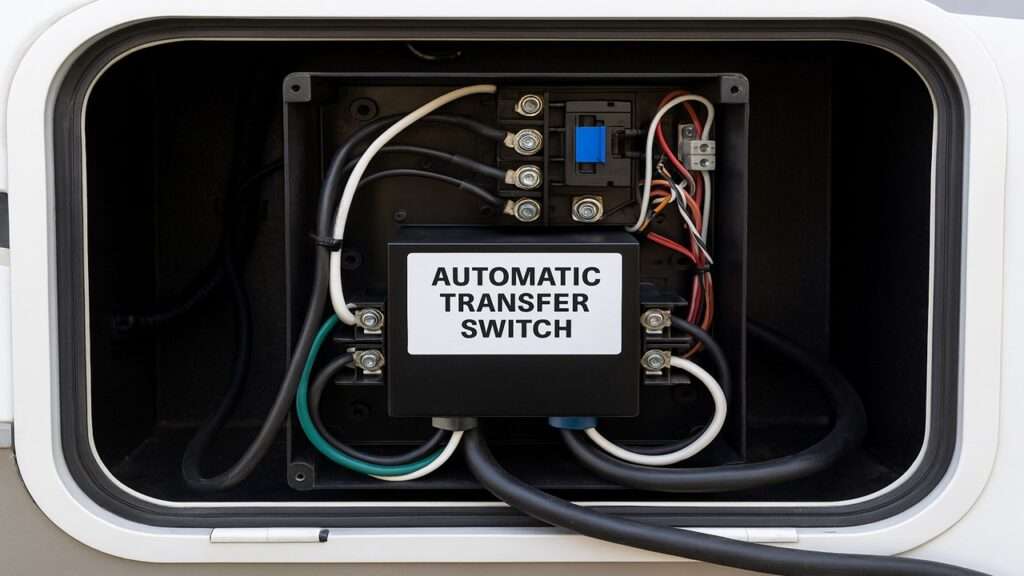
An ATS in an RV is a relay-based controller that automatically routes your RV’s AC system to the active source, whether that is shore power, a generator, or an inverter. It also blocks any tie between sources. Start the generator while plugged into shore and the ATS senses it, waits for stable output, transfers the load, then returns to shore when the generator stops. This predictable “traffic cop” behavior keeps power stable and prevents dangerous source conflicts.
Why Do RVs Need an ATS?
Without an ATS you must unplug and replug cords or flip switches whenever you change sources, which invites mistakes and downtime. An ATS eliminates those risks and streamlines power management for rigs that use more than one source.
- Prevents backfeeding into the park pedestal or grid.
- Eliminates manual errors that can damage equipment.
- Connects only a single, stable source at a time to protect appliances.
- Simplifies life when you run shore, generator, and inverter in one system.
Benefits of Using an ATS
The benefits go beyond convenience. A well-chosen ATS makes your electrical system safer, smoother, and easier to live with.
- Safety: Interlocked contactors ensure sources never close together.
- Automatic control: Source changes happen hands-free based on priority.
- Stable transfers: A timed delay lets generator voltage and frequency settle.
- Longer appliance life: Avoids brown-in starts and surge events that stress compressors and electronics.
Placement tip: Decide where to place your energy management system (EMS) relative to the ATS. After the ATS can protect from both shore and generator faults. Before the ATS can shield the ATS itself from a bad pedestal. Choose based on your equipment and goals.
How Does an ATS Work?
An RV automatic transfer switch (ATS) detects available power sources and connects the appropriate one to your RV’s electrical system. It automatically switches between shore power and generator power while keeping both sources separated.
Shore Power to Generator Switching
When you start your RV generator, a generator-priority ATS detects its output and switches from shore power after a short delay. Once the generator stops, the ATS reconnects shore power if available. However, power source priority depends on the ATS model.
Transfer Delay Mechanism
Many RV transfer switches wait approximately 20 to 45 seconds before connecting generator power. This delay allows the generator to warm up and stabilize its voltage and frequency. It helps protect your RV appliances from unstable startup power.
Safety Interlocks
An ATS uses internal electrical contacts to prevent shore power and generator power from connecting simultaneously. This separation prevents dangerous backfeeding and reduces the risk of electrical damage.
Types of Transfer Switches in RVs
RVs generally use manual or automatic transfer switches. Both can safely manage multiple power sources, but they differ in operation, convenience, and cost.
Manual Transfer Switch
A manual transfer switch requires you to select the power source yourself. You typically operate a switch or change a designated plug connection. It’s affordable and straightforward, but switching power requires your attention.
Automatic Transfer Switch
An automatic transfer switch detects available power and changes sources without manual intervention. It’s particularly convenient for RVs with onboard generators. Although more expensive, an ATS makes everyday power management easier and more convenient.
Manual vs Automatic (at a glance)
| Feature | Manual Transfer Switch | Automatic Transfer Switch |
| Switching method | User flips or moves connection | Switches automatically |
| Safety protection | Depends on the user | Built-in interlocks and control logic |
| Convenience | Low | High |
| Cost | Lower upfront | Higher upfront |
| Typical use | Small trailers, budget builds | Class A or C motorhomes, full-time rigs |
Critical Nuances Most Guides Miss
A few details separate a safe, quiet system from one that trips breakers or damages gear. These three points save the most headaches.
50-Amp RV Service Is Split-Phase
A 50 amp RV service provides two 120 volt hot legs (L1 and L2) that are 180 degrees out of phase with a shared neutral. This supports more simultaneous load and, in some cases, true 240 volt equipment across L1 and L2. Balance heavy loads across legs to protect the breaker and neutral.
When You Need a Switched-Neutral ATS
If your generator bonds neutral to ground, choose a 3-pole ATS that switches the neutral. This prevents parallel neutral paths and nuisance GFCI trips at the pedestal. It also reduces shock risk from improper bonding.
Inverter or Charger Interactions
Many inverter or charger units include a small internal transfer relay for limited circuits. Whole-coach systems or higher currents still need an external ATS. Confirm the relay rating, define source priority, and avoid creating any path that lets the inverter backfeed another source.
Common Problems With ATS Units
Failures usually appear as one source not passing power, relay chatter, heat discoloration at lugs, or error lights. A careful check can isolate whether the problem is upstream, inside the ATS, or downstream.
- Only one source powers the RV while the other never transfers.
- No audible “click” when the generator starts.
- Loose or burned wires inside the ATS from heat or poor torque.
- Solid or flashing error indicators on the housing.
Quick, safe troubleshooting for qualified users:
- Turn all sources off. Inspect lugs for discoloration and re-torque to the manufacturer’s specification.
- Shore test for 50 amp: L1 to neutral about 120 V, L2 to neutral about 120 V, L1 to L2 about 240 V at the ATS input. If those values are wrong, the pedestal is the issue.
- Generator test: After the delay, confirm the generator contactor engages and each hot to neutral reads about 120 V at output. If input is good and output is dead, suspect the contactor or control board.
- If a GFCI pedestal trips at plug-in, investigate neutral-to-ground bond conflicts and inverter pass-through wiring.
NOTE: If you are not trained for line-voltage work, call a certified RV electrician.
ATS Sizes and Ratings (30A vs 50A)
Match the ATS to your service and confirm how many poles are switched. The right choice prevents overheating and stray neutral issues.
| Feature | 30 Amp ATS | 50 Amp ATS |
| RV type | Small to mid-size rigs | Large coaches and high-demand rigs |
| Power handling | About 3,600 W (120 V × 30 A) | Up to about 12,000 W across two 120 V legs |
| Appliance capacity | Limited simultaneous use | Multiple heavy loads at once |
| Typical setup | Single A/C and basic galley loads | Dual A/Cs, washer or dryer, induction, etc. |
| Notes | Usually 2-pole hots | 2-pole hots; use 3-pole (neutral switched) if the generator is bonded |
Do You Need an ATS in Your RV?
If you only use shore power, a manual approach can work and a hardwired EMS may be all you need. If you have an onboard generator or an inverter feeding branch circuits, an ATS is strongly recommended. It removes guesswork, prevents unsafe ties, protects appliances during transfers, and makes day-to-day life simpler. For full-timers or anyone running multiple air conditioners, an ATS is essentially standard equipment.
Buying Guide: Choose the Right ATS
- Match your service: 30 amp vs 50 amp must align with the RV.
- Choose the neutral strategy: use a switched-neutral (3-pole) ATS if the generator is neutral-bonded.
- Confirm the delay: look for a documented generator warm-up delay near 20 to 45 seconds.
- Verify inverter compatibility: check the inverter’s internal transfer rating and decide whether you still need an external ATS for whole-coach loads.
- Plan EMS placement: after the ATS protects from both shore and generator faults; before the ATS protects the ATS from bad pedestals. Pick the layout that matches your gear and goals.
Final Words
An ATS is the silent manager of your RV’s electrical system. It prevents source conflicts, delays connection until power is stable, and shields appliances from problems you might never see but would surely pay for. Match the ATS to your service, choose the correct neutral strategy, place your EMS thoughtfully, and use a qualified technician for installation. Do that and you will have years of reliable, worry-free power on the road.
Related FAQs
Can I run both generator and shore power without an ATS?
No. Tying sources together risks equipment damage and backfeeding. An ATS prevents two sources from closing at the same time.
Why does my ATS wait about 30 seconds before switching to generator?
That delay lets voltage and frequency stabilize, which protects motors and electronics from brown-in conditions.
Do I need a switched-neutral ATS?
Yes if your generator is neutral-bonded. Switching the neutral prevents parallel current paths and nuisance GFCI trips.
Where should my EMS or surge protector go?
After the ATS protects from both shore and generator faults. Before the ATS protects the ATS from a bad pedestal. Select the layout that best fits your equipment.
Is a 50 amp RV actually 240 volts?
A 50 amp RV service is split-phase. It provides two 120 volt legs that are out of phase with a shared neutral. Some equipment can use 240 volts across L1 and L2, but most RV loads are 120 volts.

Jack Rivers is a long-time RVer, a husband, and a dad who’s traveled solo and now with his family. He’s learned a lot from years on the road, sometimes the hard way. From quiet mornings parked by the woods to messy evenings with the kids and a busted heater, he’s been through it all. Miles writes to share the real stuff, the small wins, and the lessons that make RV life worth it, no matter who you’re traveling with.